
9 Things Kids Used To Learn Just By Living Life That Parents Now Have To Teach On Purpose
 Tomsickova Tatyana / Shutterstock
Just a few decades ago, kids had independence at home and out in the world that helped build their resilience, but because they didn't always have a strong support system at home, they may still struggle with emotional security as adults.
Today, kids are more likely to have a safe emotional space with their parents, but they also have less room to make mistakes and figure things out on their own. Because of this, many of the lessons and skills kids used to learn just going about their daily lives have to be taught with care and intention, and often, they simply aren't.
9 things parents today have to teach their kids on purpose that children used to just learn by living their lives:
1. How to do simple chores
 Pics Five | Shutterstock.com
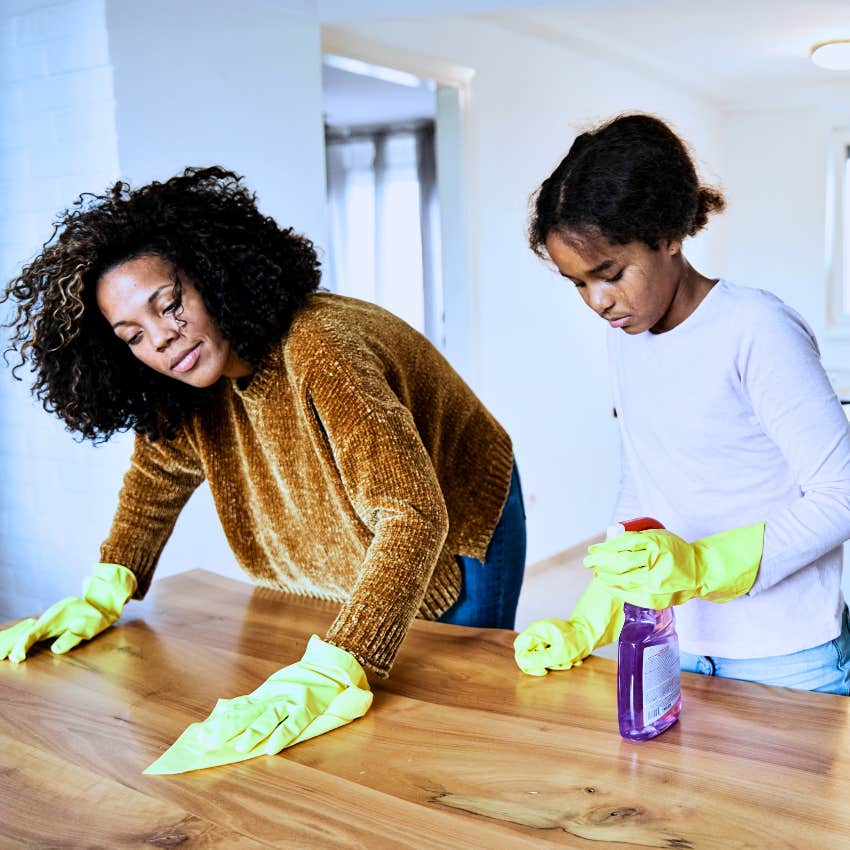
Many chores in 70s, 80s, and 90s households were a child’s responsibility, but that didn’t mean they were taught constant daily lessons. For many, the sink-or-swim mentality was still alive and well, and they had to figure out how to get their chore list done without having a micromanaging parent supervising every move.
Parents today tend to be more deliberate with not only their lessons, but also with the chores they allow their kids to do at home. There’s a collective anxiety about children’s safety, which is why the chores of Gen X and boomers’ childhoods, like ironing clothes or cooking at the stove, are now often only a parent’s duty.
2. How to advocate for themselves
While overbearing parents today tend to advocate for their kids in friendships or with teachers at school, Gen X and boomer kids learned to advocate for themselves. Of course, there’s a healthy middle ground between completely parentified children and overprotective parents when it comes to resolving conflict, but it’s important for kids to find their own voice.
Parents today often have to teach their kids all sorts of social skills, including this kind of communication and confidence in social settings. While it might take less time, many of the most resilient older generations had to figure it out on their own.
3. Sitting with hard emotions
While gentle parents today actively sit with their kids’ feelings and even give them a deliberate space to process them in the moment, a few decades ago, kids learned emotional regulation by living. In time-outs from parents and out in the world, they had to figure out how to deal with their emotions alone, for better or worse.
While gentle parents today who can understand their child’s emotional state have an advantage for helping them regulate in the moment, sometimes kids really do need the space to figure it out on their own.
4. How to resolve conflicts
Out on their own in the world, playing with neighborhood kids and advocating for their kids at school, old-school kids had to learn how to resolve conflicts on their own. They didn’t have a parent willing to advocate for them all the time or mediate their conversations.
The best parents today don’t just teach lessons directly to their kids. They model healthy conflict-resolution skills by having hard conversations in front of their kids instead of hiding taboo topics and heated arguments, and, most importantly, resolving them with their kids as witnesses.
5. Street smarts
 Lopolo | Shutterstock.com
Many kids a few decades ago were used to being sent out on their own to entertain themselves. They were left on their own much of the time, without the kind of overbearing parents who keep a close eye on their kids today.
They developed street smarts by running errands and playing with neighborhood kids. Now parents have to teach their kids to be skeptical and look out for their safety, but most of the time, they have parents to guide and protect them.
6. Talking to strangers
Especially today, when kids face the risk of being both isolated and overly anxious in social settings in our digital world, many parents have to intentionally teach their kids how to speak to strangers. Whether it’s going out and having them order at restaurants or helping them start conversations with friends, the best parents push their kids out of their social comfort zones.
For Gen X and boomers, this is a parenting habit they never thought to prioritize. Especially for kids who spent most of their time alone, inside and outside the house, they learned it by practicing. They developed not only social skills, but social awareness and common sense by trying and failing. While many of these kids look back in awe at being left to their own devices out in the world, many are grateful today that they’re comfortable enough in their skin to talk to anyone, in any circumstance.
7. Entertaining themselves
While kids today have constant stimulation and entertainment at their fingertips, along with parents who feel responsible for keeping them busy and monitoring their schedules, old-school kids dealt with boredom by facing it head-on.
They were sent out into the world and their neighborhoods without supervision or a plan. While it might seem scary and controversial for modern parents, this kind of unstructured play and boredom is essential for kids to build not only creativity, but also emotional intelligence, problem-solving skills, and a secure sense of identity.
8. Managing their time and obligations
Many kids a few decades ago were given free time and a to-do list and expected to figure it out. They were responsible for getting their homework done, making their lunches, getting ready for school, and showing up on time, often without a ton of parental supervision.
Kids today are somewhat the opposite, with supervising parents who schedule their extracurriculars and take on the responsibility of managing their time for them. They have to intentionally teach time management, but don’t often give their kids full responsibility to learn it themselves.
9. Tolerating discomfort
 Irina WS | Shutterstock.com
We have to learn how to tolerate discomfort and even seek it out to grow, at least before adulthood. If not, we end up stuck in our comfort zones, seeking ease and convenience instead of the challenges we need to evolve.
Kids a few decades ago faced discomfort regularly, whether it was with problems on their own time or with boredom and no screen stimulation to entertain themselves. Kids today have parents teaching them how to handle discomfort, not naturally, but in curated environments, if they get it at all.
Zayda Slabbekoorn is a senior editorial strategist with a bachelor’s degree in social relations & policy and gender studies who focuses on psychology, relationships, self-help, and human interest stories.

