
My Father Died At 58, And It Took Me Years To Realize How Young He Really Was
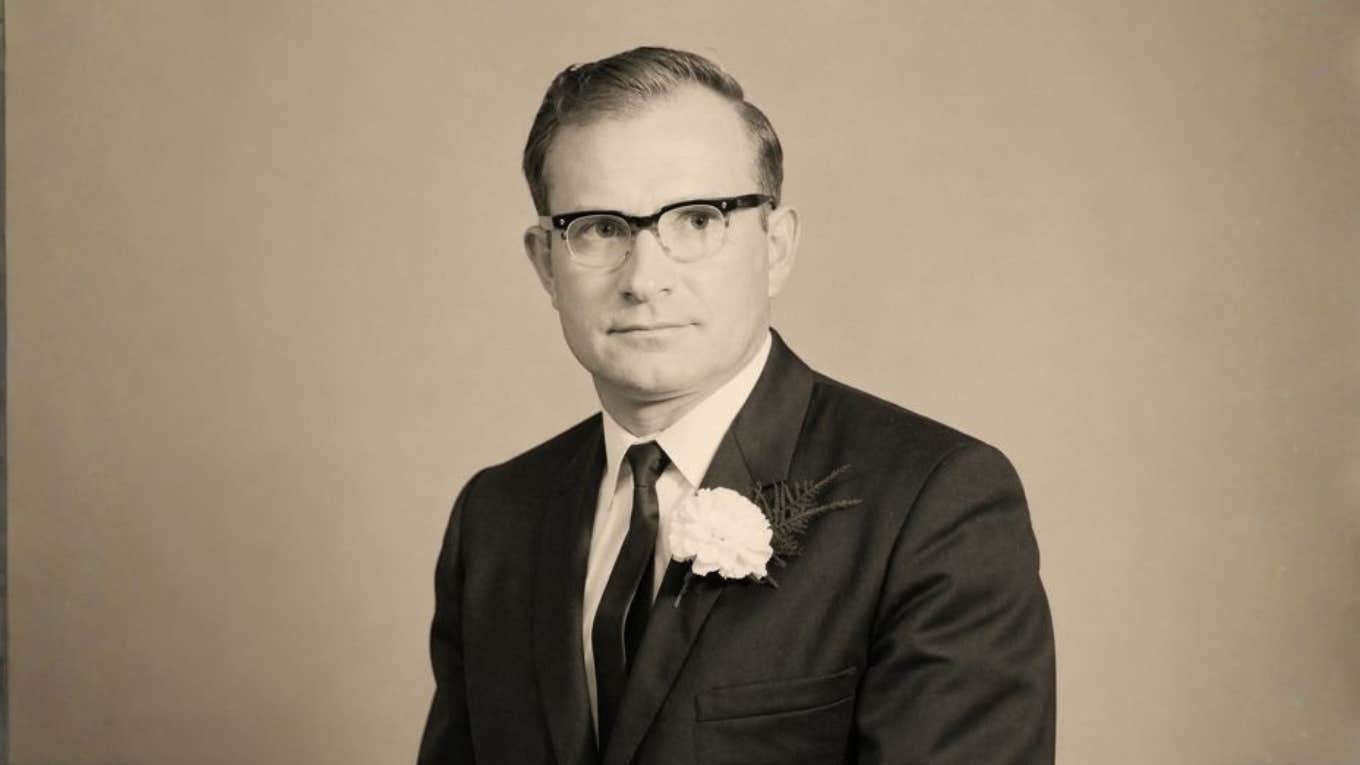 Courtesy Of Author
The phone rang from the office attached to our classroom. Hans, my chef instructor, excused himself from lecturing, stepped into his office, and closed the door. A moment later, he returned and called my name, “Arpad, there’s a call for you.” I rose, went to the office door. Hans placed a hand on my shoulder and gave it a pat, “Please close the door and take your time.”
At his desk, I raised the receiver, “Hello, this is Arpad.” The voice on the other end of the line identified himself as an RCMP Constable. He was direct and delivered a succinct message. I mumbled a “Thank you” and returned the receiver to its cradle. The news was not unexpected, but at the same time, it seemed impossible.
It was 1994, I was 21 years old, and my father had died a few hours earlier at age 58.
Cancer was the victor. I didn’t know until later, but while I was in the chef’s office, Hans informed the class of my loss. The small assembly of the 3rd- and final-year aspiring professional cooks was like a distant family. Over the past three years, mostly the same group gathered at the vocational college for the six-week classroom segment of our three-year apprenticeship program.
I remember thinking that I didn’t want to quit. Not them or the program. My father was dead, but it felt automatic to move with my group to the kitchen lab. It was butchering day, and I needed to pass the assignment on breaking down a side of beef into primary and secondary cuts; my knives were sharp, but my brain was dull. I was in a new territory and didn’t have a map. I felt adrift; of myself, of my family, of the present and the future.
Chef Hans tried to dissuade me from the practical exam, but I assured him I was fine to go ahead. Ten minutes into it, he returned to my side, took the knife from my hand, and told me I really should go home. Though unaware of it then, and no recollection now, I was told that I stood at my station, carving knife in hand, staring at the beef slab.
A few hours later, I was in the car with my brother, an elementary school teacher in the same city, and we drove through the night, headed home to our stepmother, little sister, and a father who would remain forever beyond our reach. Neither of us had any final words with our father. By our adult years, neither of us remained particularly close to him, but we both loved and admired him for different things, in our individual ways.
During the eight-hour drive, my brother, being older, did what he was supposed to: he spoke about our father in good ways. We laughed, recalling our narrow escapes from his wrath, the times we didn’t, who got it worse (me), and debated which of us disappointed him most (I won again.) We did not cry then, nor a few days later at the funeral. My brother returned to work. I did not return to school and delayed completing my apprenticeship by 6 months.
Earlier this month, I led my family to the western slopes of British Columbia for a weeklong ski vacation. We stopped to visit my brother and his wife, who live at the halfway point of the 10-hour drive. As we toured his cozy home, I saw several pictures of our father. I took them down from the shelves for a closer look, and my brother, three years older, commented that he’s nearly the age our father was when he passed.
“I’m conscious of the date. It’ll be something to make it past his age,” he said, standing beside me as we both looked at the framed photographs. While my brother sees it as a landmark event, and I also have the marker in the back of my mind, I consciously put it aside. My goal is to live much longer, and I don’t allow myself to hold our father’s death date as a finish line. Somewhat like superstition, I don’t want to hex myself.
I think more often of my father as I age into my fifties — 58 is much too young to call a long life.
 Anita Jankovic / Unsplash
I catch myself mimicking his mannerisms, asking and answering questions aloud, evaluating life’s issues with sighs of resignation, and whispering prayers and complaints to the Holy Mother and the Saints. Like him, I go barefoot on the earth at every opportunity, and I’m always working.
I’ve also learned to appreciate the value and pleasure of late afternoon naps. In my observations, fewer of us (people as a whole) have or have had easy life stories than those who have faced traumatic experiences. The mechanisms of life chewed my father up and spit him out.
He was 20 years old in 1956 when the Hungarian revolution broke out. At the time, he was serving his mandatory conscription in the Hungarian Army, a national force in name but with the Russian red star stitched onto the uniform.
As the chaos erupted and freedom felt achievable, he became a turncoat, releasing weapons from the army base and joining the fight against his Russian oppressors. A week later, the revolution collapsed. Marked as a traitor with a shoot-on-sight execution order attached to his name, he had no choice but to flee. Like many thousands of fugitives, he escaped.
I don’t believe people today realize the trauma of losing their homeland. Today, borders hold less value and little risk. We cross them at will with little concern for where our feet land or of any impediment from sauntering back to home soil. During the Cold War, you couldn’t just walk across a border; in was in and out was gone.
My father was fiercely patriotic. Most people of the small Eastern European nations are and silently carry their national anthems with each breath. If you’re not from those lands, you can’t understand because patriotism here in Canada and the USA is not the same thing. National pride, in the old country, goes back thousands of years. As does the hate toward the oppressive abusers.
To clarify the “fiercely patriotic” statement, my father’s ambition wasn’t to raise a family with more opportunities and less danger, nor was it the “American/Canadian dream” of living in abundance and creating generational wealth. If those situations had occurred, it would have brought him comfort, no doubt, but not peace, not satisfaction.
His purpose was to have sons — ideally seven, one son for each of the Hungarian nomadic tribes that formed Hungary — and to lead them home, arms raised with a pistol in one hand and a scabbard in the other to drive the communists out, once and for all.
Canada in the 1960s was booming and in need of skilled tradespeople. With my father, a certified machinist, the country welcomed him. By determination and charm, a lot of bribe payments and government assistance, he managed to extract his sweetheart from Hungary. They married in 1969 in Winnipeg, Manitoba; he was 33, she was 20. They moved west to British Columbia and became parents, first in 1970 with my brother, and again in 1973 with me.
I was three months old when she died. My father was 37. It was death by suicide and not a private affair. He returned from work and took his place on the recliner. She walked out of the bedroom, sat in his lap, put a pistol to her head, and pulled the trigger. Scratch one country to tyranny, scratch one love of your life to mental illness.
To make a tragic story worse, as I grew, my face grew more and more to be the spit of my mother’s. I can scarcely imagine the pain of such a cruel joke, spending each day having to look at the face of your greatest love, heartbreak, and trauma. Closeness with me was impossible. He wanted to forget, and I wouldn’t let him.
My child is now 16 and growing toward adulthood, so I can't help but think of my age and my father’s
 Yaroslav Shuraev / Pexels
He married at 33. I married at 30. He was 37 when I was born; fatherhood came to me at 36. I’ve been an enthusiastically active and involved father from the beginning and have never felt “old” as a dad. Thinking about my childhood and my father, I can’t remember ever thinking of him as young, but he was. Even looking back at the pictures in my brother’s house and in my memories, my father looked as old as I recall.
Stiff, stern, and strict, I have to look hard to find memories of him, loose, laughing, and loving life. He had thin, light brown/blondish hair with an early widow’s peak. It only whitened with the cancer, although I know I caused the greys at his temples. I was a very difficult son.
I wonder why it’s so challenging for some of us to see our parents as young. Does it stem from the relationships between parents and their children? My mother-in-law is 91, and none of her nine children thinks of her as “old.”
All of them are very close to their mother and each other. To me, she looks and feels more youthful than my stepmother, who’s more than a decade younger. The family dynamics in our remaining crew of four have been fraught with stress and trauma. I have a good relationship with my stepmother, but my brother is estranged from her.
It is a little more challenging to stay connected with your children in their late teens. They live in a different generation, and relating to one another sometimes gets lost in translation. They have a separate language, creating new and confusing slang and inventing stupid words like “unalived,” so it takes effort, and we try.
I know that my father tried so hard, but I didn’t see it for what it was at the time
 Getty Images / Unsplash+
In my teenage years, I shut my parents out, believing they could never understand my plight. Today, my teen just looks at me and begs me not to try. I asked if I was “old” and got the opposite answer from how I saw my father. “Old? No way! You and Mom are fun. All my friends love you guys, and I think you and Mom are both too interesting to be old. Don’t worry, you’re pretty cool for a dad.”
Perhaps that’s the blessing of youth. You don’t really comprehend age in the present moment. You’re not far enough along to look behind you, and not experienced enough to see ahead. You’re a kid, and they’re just your parents. Still, it’s strange, and it bothers me that I can’t reconcile that my father was my age all the years I’ve been a dad.
When the cancer came and my father aged and deteriorated rapidly, I was still living in our hometown. I saw him often, and if there is a blessing in an illness striking a parent, especially one with whom the relationship has been tenuous, it’s that a certain amount of grace arrives.
Instead of looking at me and seeing failure, I believe he saw potential, or at least an aptitude to succeed. As his hair and beard turned snow white and his chest went from barrel-shaped to sunken, we had some necessary discussions. I felt forgiveness where I had only felt judgment.
Not long before I left for school, in the final weeks when he was still clear in mind and coherent in speech, I sat with him as he lay in the veranda he’d built as an extension on the back of our house. Surrounded by windows above walls lined with plants and flowers constantly attended to by my green-thumb wizard stepmother, he slipped back in time and brought up my mother’s name. “She was never here, your mother,” he said.
It shocked me, as speaking of her had been an exceedingly rare occurrence, and the statement caused the familiar, immediate emotional resistance I always felt when she was the subject. In earlier times, when I dared to ask about her, he would often exit the conversation, verbally and physically. If he mentioned her, I would often do the same with walls going up internally.
Instead, I waited, said nothing, and hoped to hear something more. After a few minutes, he continued, “She was too beautiful. She was an artist. Her fingers were like feathers. She was a bird, floating above the grass. I think God made a mistake and she didn’t belong here.”
I felt frightened to look at him. We didn’t have heart-to-hearts. We had not been gentle to each other, but I heard something like a plea in his voice, for me, him, or her, I cannot say. I looked and saw tears running into the hollows of once full cheeks. I mumbled something sympathetic, though I felt numb.
“I wish she could have stayed,” he said. “But I think I will see her soon.”
I miss my dad more now than I did in the years after his passing
I miss that he never met my wife, whom I know he would have adored, charmed, and been enchanted by. I miss that he didn’t meet his grandchild. I think he would have approved and tried to recruit one more patriotic warrior.
I’m five years away from the age of his end. I hope to live twenty years past it so that I can look back and see that I was young, and fully understand that all he endured, all he did, made the life I have today possible.
Arpad Nagy is a 52-year-old, Hungarian Canadian, working husband and father, who began his writing journey in 2021 after sustaining serious work injuries. His fiction writing, nonfiction essays, and memoirs have achieved a measure of success, most recently shortlisted for the 2024 Northwind Writing Award in fiction and nonfiction memoir, as well as being accepted as a feature author for Dragon Soul Press Winter Anthology. Several of his short fiction stories have been read to audiences on podcasts.

